
Written by: Dianna Candido
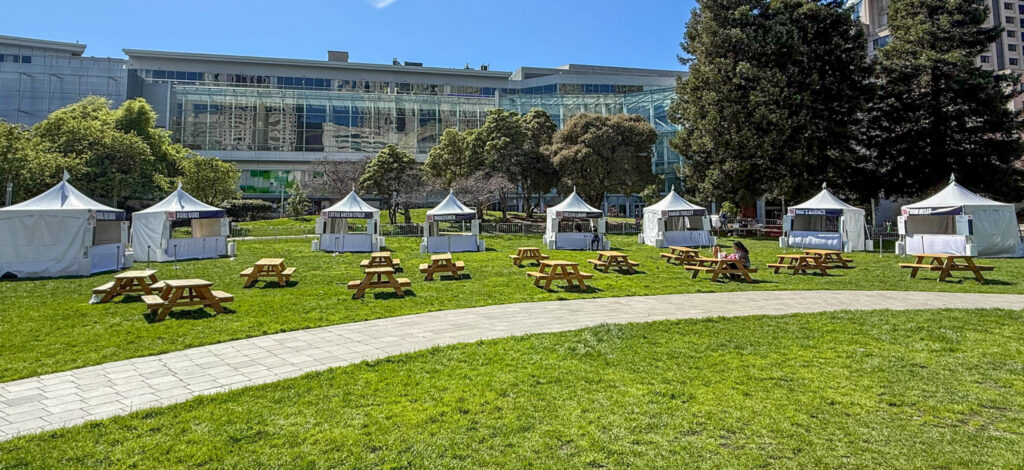
Planning an event usually starts with a vision. There’s an idea of what the decor and theme will look like, what kind of guests will come, and the experience they’ll have. Maybe there’s catering involved and entertainment, and you start thinking about booking that venue that has the perfect outdoor space.
If you’re planning an event, those aspects are usually top of mind. What’s not top of mind? Permits.
Safety should always be the top priority. Permits ensure the safety of guests and people in the surrounding area if your event is in a public area. But they’re one of the pieces of planning that sneak under the radar because of all the other flashy details that get attention first.
So what are the event tent permit requirements for the Bay Area, and do you need one for your event?
What Many Planners Miss About Event Tent Permitting
Our clients rarely ask about permits, which is why we do. This is a conversation we need to have proactively, because if we don’t get proper permitting, there’s a risk that your event gets shut down or is unsafe. Either way, it’s not good.
Additionally, the process for getting permits is complex. “The review process can be long,” says Austin Venezia, Jr. Account Manager. “It requires submitting a lot of detailed information.” He’s right. A lot goes into permit applications, so the earlier you start the process, the better.
Event Tent Permitting Details You Need to Know
Tent permitting and compliance shift depending on your location. California state law has strict rules around tent permitting, but each county and city may layer its own requirements.
Even within San Francisco, the rules are subject to change depending on your exact location. “SF requires a minimum of 5 lbs. of anchoring per square foot,” explains Chantal Call, Account Executive, “but if you’re near the water (think the Embarcadero or any of the piers), that jumps to 10 lbs./sq. ft. due to high winds. A 10×10 tent near Pier 39 needs 1,000 lbs. of anchoring.” This is the sort of detail that can take you by surprise. Chantal sees this happen frequently. “The weight requirements catch everyone off guard,” she says. “Safety in SF is no joke, and the fire marshal will check.”
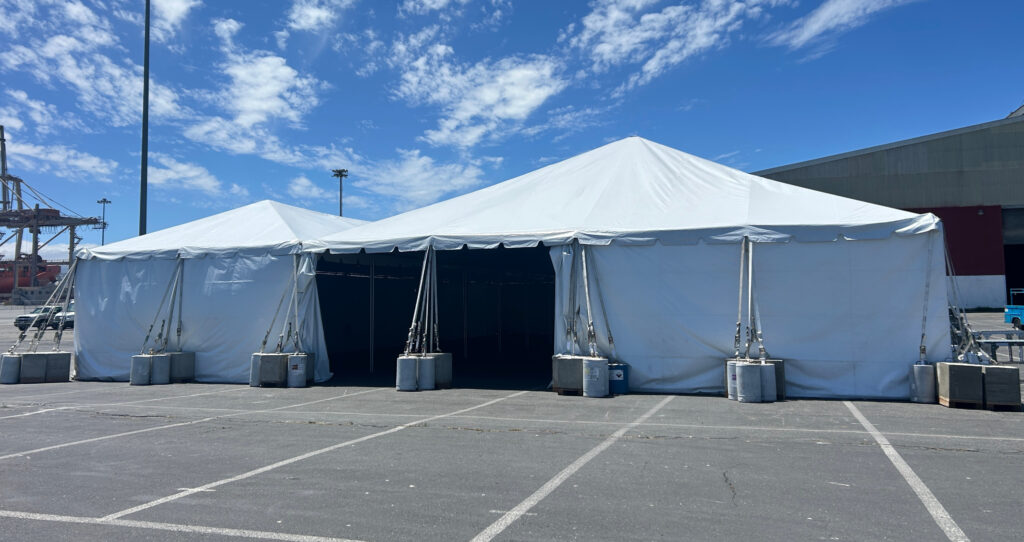
They’ll also check to make sure you have all the permits you need — because you might need more than one.
Temporary structure permits, open flame permits, and event tent permits aren’t the same. Temporary structure permits can cover things like stages and other large structures; tent permits are specifically for tents. There are many different types of open flame permits, and the type of permit changes depending on what kind of flame (a sterno for catering, outdoor heaters, or a small candle on a table, for example).
If you prefer to manage permits yourself, contact your local fire authority. If you’re unsure, you can reach out to us directly. It’s a good idea to get insight from someone who deals with permits for events regularly to ensure your event is up to code.
Is it really worth getting a tent for your event?
Our take? Absolutely. “Bay Area weather is unpredictable — fog, wind, and temperature drops can happen any time of year,” said Chantal. “A tent gives guests comfort and keeps the event on track no matter what the weather decides to do.”
Our team sees enough events to know what the best move is. So what kind of experience do you want to give your guests? Sometimes, weather and location come together to give a perfect outdoor experience. But if not, the tent is the perfect outdoor event solution. A tent “allows the event to flow smoothly and helps people feel comfortable and protected,” says Dany Rodriguez, Jr. Account Manager. “The tent is there to guarantee the best guest experience. It’s not an ‘I want a tent’ but an ‘I need a tent.’”
If you’re on the fence, we recommend a tent to ensure guest comfort.
Compliance extends beyond the tent.
Yes, the safety of the event tent structure is a big concern. But there’s more to it.
Chantal explains, “[Permitting] goes beyond the tent itself; exit signage, fire extinguisher placement, aisle widths, and furniture layouts can all fall under fire code, depending on the city. Inspectors do show up.”
There are occupancy thresholds for tented events that can affect the type of permit you need, as well as details you may need to add, such as exit lighting and signage. For example, in San Francisco, the San Francisco Fire Department requires a Place of Assembly Permit for events with 50+ guests, and emergency lighting requirements change for 300+ guests.
The only way to know for sure that your event is compliant is to get all the necessary documentation done for permitting and apply for the proper permits. That’s why it’s so important we open the conversation with our clients early. “We make sure everything is in order well before event day,” Chantal explains. No one wants the stress of potential shutdowns on the day of, or worse, an actual safety issue.
Who handles tent permitting?
You can do it yourself by talking to your local fire authority. If you’re a professional planner, you can do it for your clients or you can get support from trusted industry professionals like us.
For Unica, it’s essential that our clients get permitting done on time and in compliance with state and local regulations. Safety is our number one priority for every event.
“We manage the blueprints and coordinate with the local fire department to make sure everything meets code,” says Chantal. We know what the process looks like, and compliance won’t be overlooked if our team is part of planning an event.If you’re planning an event and want support from professionals who understand how to keep things on track, tell us about your event. We’re here to help get your event into compliance with all the proper permits in place for a memorable and smooth event.
